Ombudsman Questions and Answers about COVID-19
The Centers for Medicare & Medicaid Services • March 20, 2020

The Centers for Medicare & Medicaid Services released revised and expanded
guidance for nursing homes on responding to COVID-19. This letter provides detailed direction on new visitor restrictions imposed to help nursing homes control and prevent the spread of infection.
- Residents still have the right to access the Ombudsman program.
- Their access should be restricted per the guidance above (except in compassionate care situations), however, facilities may review this on a case by case basis.
- If in-person access is not available due to infection control concerns, facilities need to facilitate resident communication (by phone or other format) with the Ombudsman program or any other entity listed in 42 CFR § 483.10(f)(4)(i
Questions and Answers
- Can an ombudsman visit a nursing facility or assisted living facility (ALF)?
- No. All volunteers and staff are temporarily restricted from making an onsite facility visit. In special circumstances, an MLO may obtain approval from the State Ombudsman to conduct a facility visit to investigate a complaint.
- How long are ombudsman visits restricted?
- The restriction began on Friday, March 13, and will extend until at least April 15, 2020. The State Ombudsman will extend this time frame if necessary for the health and safety of LTC facility residents.
- Should I respond to complaints differently right now?
- Yes, some complaints must be reprioritized. Inform the complainant that your ability to work to resolve a complaint is temporarily limited to telephone and email contact with facility staff. Explain that facilities are instructed to prioritize issues related to infection control and abuse, and therefore, these are the issues you are also prioritizing. See guidance in the Complaint Procedures section of this document.
- How does an ombudsman work to resolve complaints during this time?
- Complaint intake, investigation, and resolution must be conducted by phone, email, and video calls such as FaceTime, Skype, and Duo. Specific procedures for this work are described in the “complaint procedures” section of this document.
- What information should I give to residents, their family members, and other concerned citizens?
- For information about COVID-19 and LTC facility operations, refer to the COVID-19 sections of these site:
Click here more information and to read the full Ombudsman Questions and Answers about COVID-19.
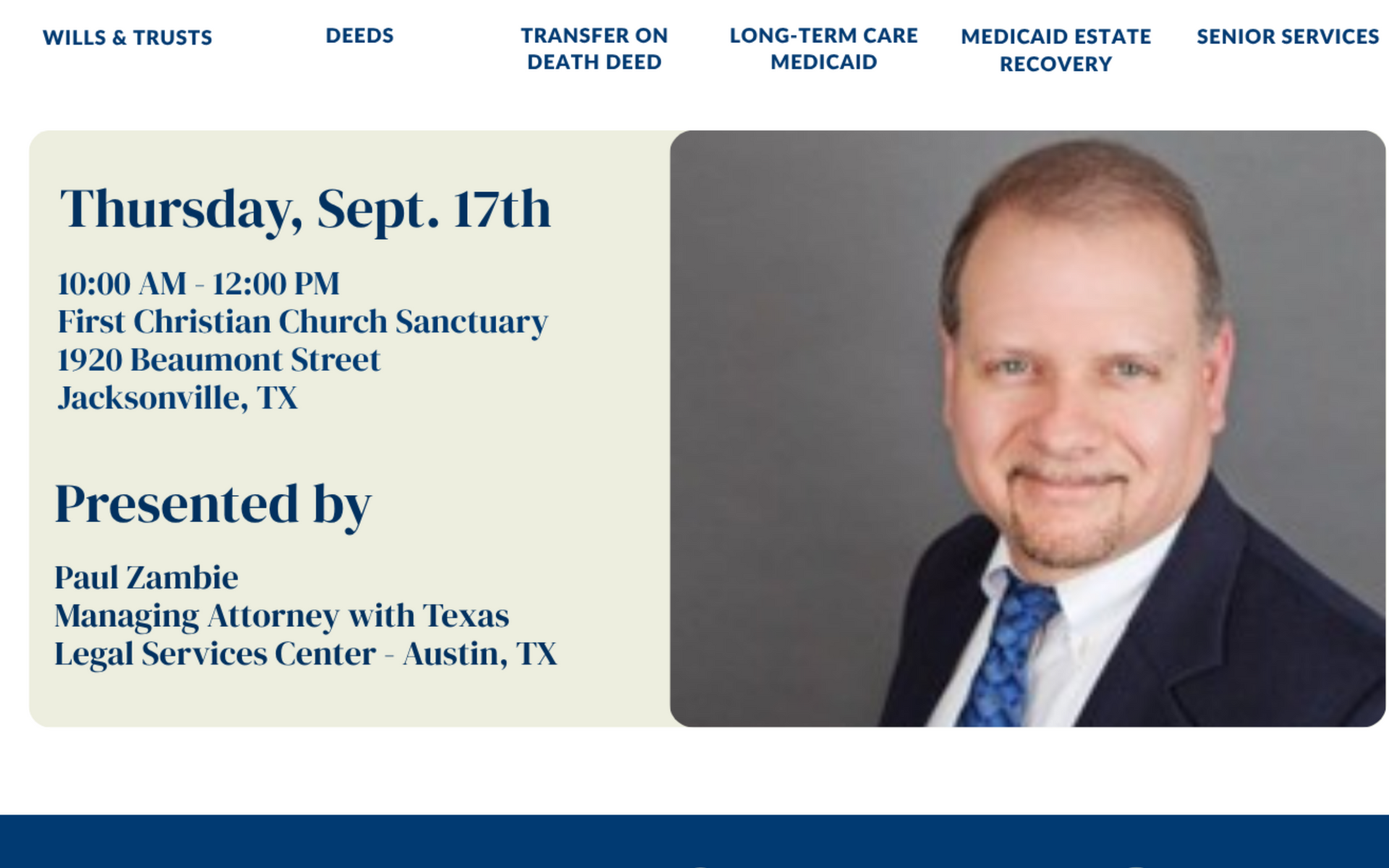
The Area Agency on Aging of East Texas is partnering with First Christian Church in Jacksonville to offer a free Benefits & Estate Planning Presentation for Seniors and Caregivers. The informative workshop will be held Thursday, September 17, from 10 a.m. to noon at the First Christian Church Sanctuary, 1920 Beaumont Street in Jacksonville. Presented by Paul Zambie, Managing Attorney with Texas Legal Services Center, the session will help attendees better understand legal and planning issues that can affect older adults and their families. Topics will include wills and trusts, deeds, transfer-on-death deeds, long-term care Medicaid, Medicaid estate recovery, and senior services. This free presentation is designed to give seniors and caregivers practical information to help prepare for life’s challenges and make informed decisions about the future. For more information, contact the Area Agency on Aging of East Texas at 903-218-6500 or 1-800-442-8845.
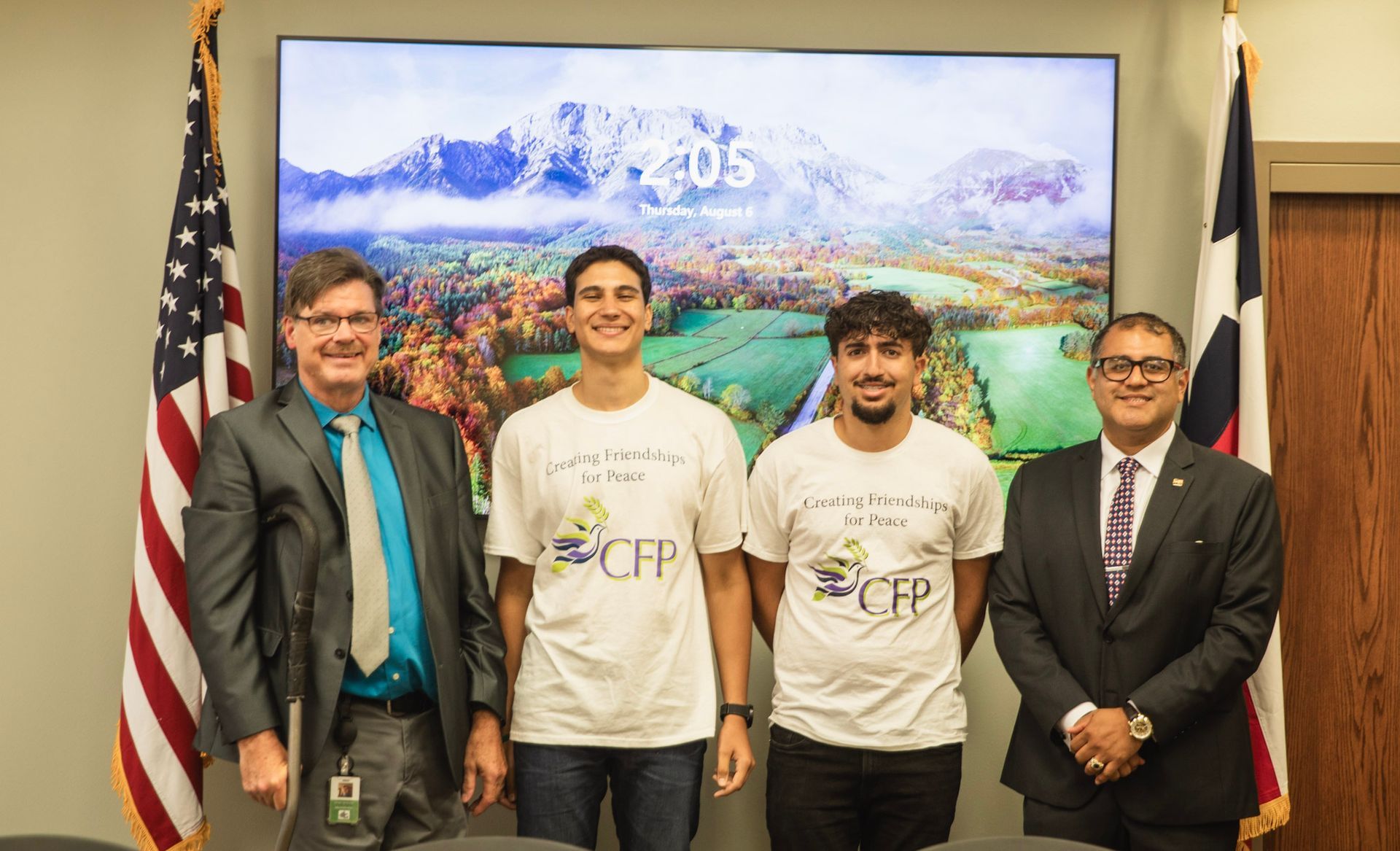
This summer, ETCOG Director of Aging Programs Adrian Cornejo welcomed an extraordinary experience into his home through his volunteer work with Creating Friendships for Peace (CFP). For one month, Adrian hosted two students from Cyprus, Michael and Derin, who came to East Texas through the CFP program. During their stay, the students shared a room in Adrian’s home, experienced daily life in the region, shadowed Adrian at ETCOG, and attended an ETCOG Executive Committee meeting. Creating Friendships for Peace brings young people from communities affected by longstanding divisions together for cultural exchange, dialogue, and relationship-building. Cyprus has been divided for decades between Greek Cypriot and Turkish Cypriot communities, with a history of conflict and mistrust that can shape how young people see those from the other side of the island. Adrian said the experience gave him a deeply personal view of how division can affect young people and how meaningful it can be when they have the opportunity to connect outside of those divisions. “What I witnessed through these young men was difficult to process,” Adrian said. “Each of their societies has, in different ways, instilled distrust, division, and even hatred toward people on the ‘other side.’ Perhaps the most heartbreaking part is hearing that this begins when they are children.” Through his involvement with CFP, Adrian also hosted two young men from Israel for a few days, one Jewish Israeli and one Arab Israeli, who similarly came from communities shaped by complex social and political divisions. “This is not a political story,” Adrian said. “It is a personal reflection on what has been one of the most emotional and humbling experiences of my life. Hearing the students’ experiences made me realize just how much we take for granted here in the United States,” he said. “We have the freedom to think, to question, and to decide for ourselves what we believe and how we treat others.” For Michael and Derin, their time in East Texas offered an opportunity to see a different community, to witness regional collaboration in action as our elected officials voted on ETCOG business, and to build friendships beyond the boundaries and assumptions they may encounter at home. “I think words are too little to describe the last four weeks,” said Michael. “This month we became a family. I was talking with Derin, and I told him it feels like we are packing to go to vacation, not home.” “I want to thank Mr. Adrian for hosting us and being part of our destiny in this trip,” said Darin. “You are very hard working and care about us. I am very grateful for you taking us to San Antonio trip, for your work, and giving us opportunities to meet wonderful people…I wish to mature up and become a person like you one day wh helps everyone like you do.” Adrian said the friendships formed through CFP demonstrate that meaningful change often starts on a personal level. “Peace doesn’t begin with governments or political agreements,” Adrian said. “Sometimes, it begins with a conversation, a friendship, and the willingness to see another person as a human being rather than as a representative of ‘the other side.’” He added that he is grateful for the friendships and perspectives the students brought into his life. “I will carry their stories, their friendship, and what I learned from them with me for a very long time,” Adrian said. ETCOG is proud to recognize Adrian’s commitment to service and his willingness to share both his home and workplace with students participating in this important exchange for peace.